published · 5 min read
My Agent Said "No Files Created." The Files Were Right There.
I had an agent test a coding agent that lives in one browser tab. Once its broken check was patched, it said done about two broken pages, one of which threw on the first click.
An AI agent drafted this from my projects, agents ran the measurements, and another agent checked the draft claim by claim against the code and the run records or briefs that were kept. The projects and opinions are mine.
MikroOS, my browser-native AI coding agent, puts it all in one browser tab: a local model on your GPU, a Linux-like shell written in JavaScript, and ten tools. It has a mode called autowork, which runs the agent and then checks that files really appeared. On my MacBook Air, autowork kept ending the same way:
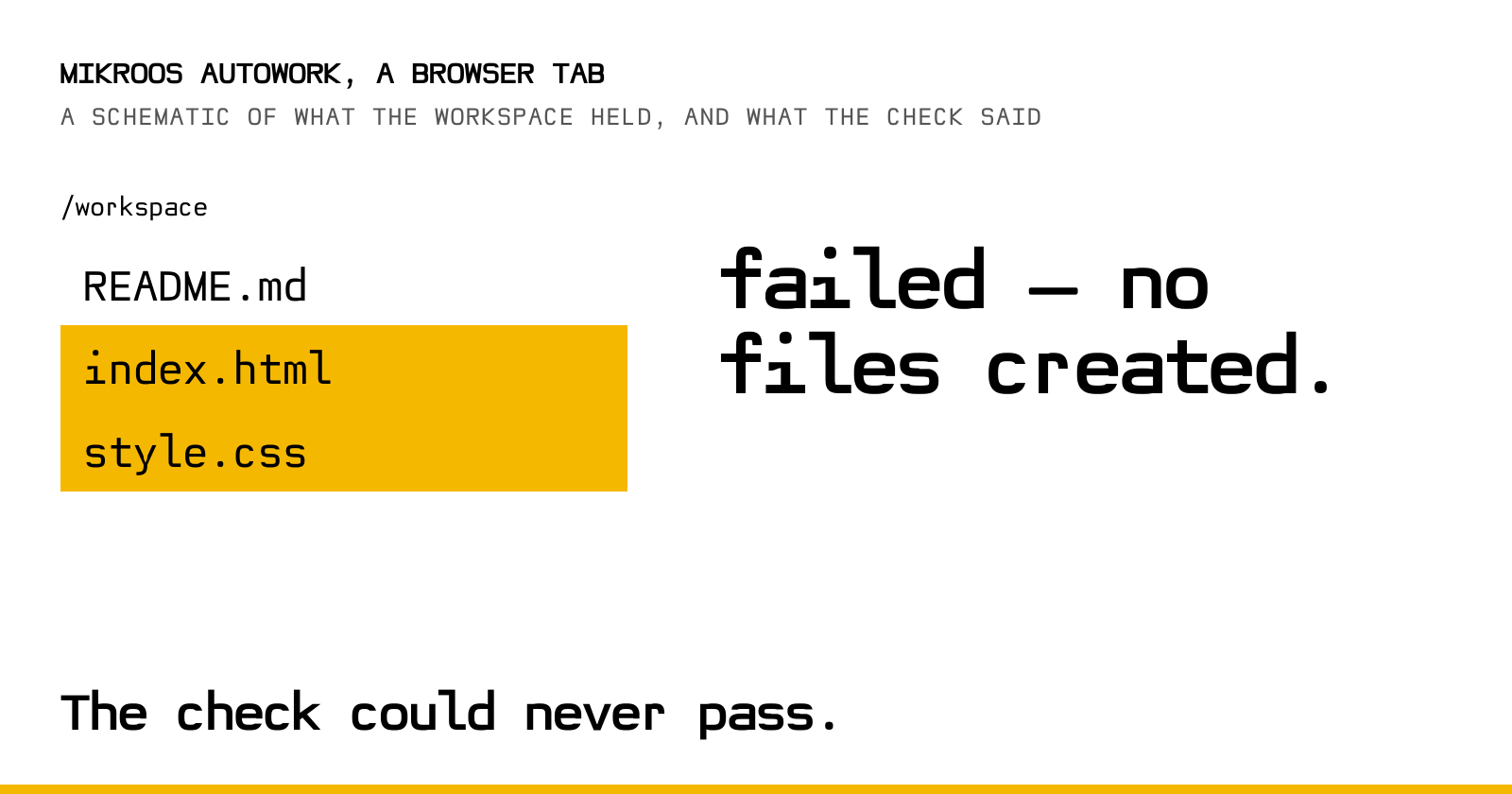
failed — no files created.
That happened on 4 of 4 runs on the smallest Qwen model, with the files sitting in /workspace each time. I had an agent run those tests. In one run the model had just said "Done. The app with a button and number is now fully functional and previewed successfully."
A check that could almost never pass
Autowork lists the workspace before and after the agent runs, and looks for anything new:
find /workspace -type f -not -name README.md
That runs inside lifo, the JavaScript shell MikroOS is built on. MikroOS pins a version that parses only -name, -type and -maxdepth, and skips any other flag without a word. -not vanishes and the test flips: the command becomes find /workspace -type f -name README.md, so before and after, the answer is just that one file, unless the agent writes another README.md. Autowork concludes that nothing was created, runs the whole agent again, and reports failure.
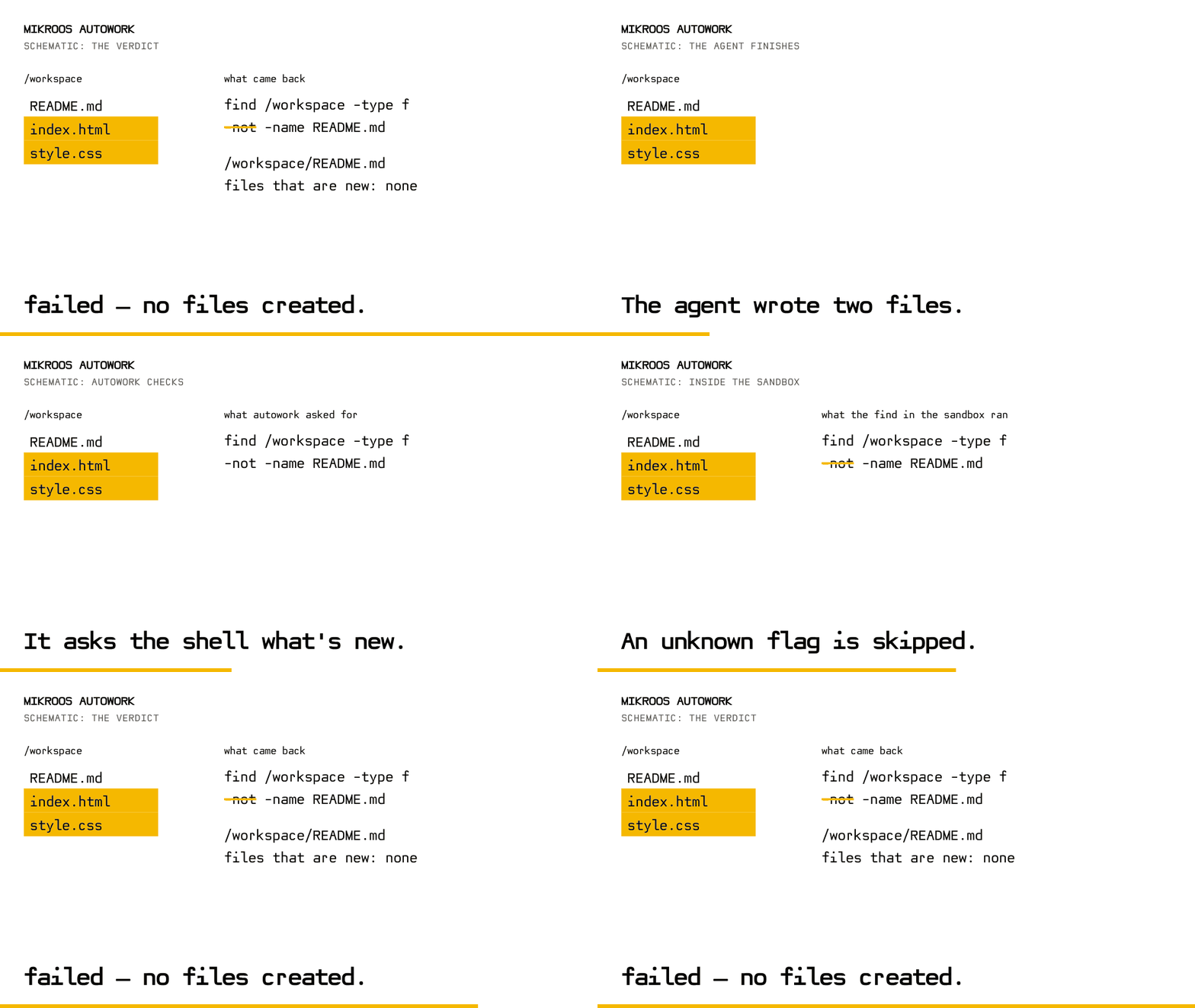
The fix is small: list everything and filter in JavaScript. With it, autowork said done on all 3 runs that finished, and 2 of those pages were broken. One run said done. 1 files: main.html about a page that throws incrementNumber is not defined the moment you click the button. Those four "failed" runs had been right by accident, because all four pages were broken too. Autowork only ever asked whether a file existed.
How the models did
The agent picked five small tasks: a counter page, a todo page, a tip calculator, a one-character bug fix, and counting lines through the shell. An outside script did the grading. Playwright clicked through the pages, node ran the fixed function, and the limit was nine minutes a run.
chat mode                       passed    note
Bonsai 1.7B (first in the list) 0 of 4    counter and fix only, 1 timeout
Qwen3 0.6B                      0 of 14
Qwen3 1.7B                      8 of 15   1 timeout
Qwen3 4B (the recommended)      1 of 3    counter only, 2 timeouts
That's a small sample on an M2 Air that was busy with other work, so read the counts as a first look. Qwen 0.6B often explained how to do the task without calling a tool. Qwen 1.7B failed in more interesting ways. Twice it printed the page in chat without writing a file. Once it renamed add to sum, and once it ended without a message after 15 turns. And on a run that passed, it fixed the bug and then reported "There is no bug to fix." The raw run files and grading scripts were lost the same evening, so the counts in this post come from notes and logs kept during the session, and the runs can't be repeated as-is.
An agent in a browser that never looks at the page
MikroOS lives in a browser, where running a page costs nothing. It already runs a previewed page, scripts on, in an iframe in the chat, yet none of the page's errors reach the model: preview returns the HTML as text. To the model, a page that throws and a page that works look alike.
So the agent tried a patch: render the page in a hidden sandboxed frame, press every button once, and give the model the errors. On 1.7B the pass rate didn't move, 5 of 8 with the check and 5 of 9 without. A run was lost to a harness crash, and only 3 of the 8 runs called preview at all. In one of those, the check reported Cannot read properties of null (reading 'addEventListener'). After that the model rewrote the page, explained that its script ran before the button existed, and the page passed. A single repair proves very little, but it's what the patch was meant to do. I haven't tested running the check on every write, and that's the next thing to try.
The prompt says "no thinking"
The system prompt ends with "no thinking. just tool calls." Qwen3 thinks by default, and the worker hides the think block, so on 1.7B the screen showed only a blinking "thinking..." line for a median 54 s before the first visible token, and for 168 s at worst. Some of that wait is likely thinking. I never measured how much. WebLLM has a real switch, extra_body: { enable_thinking: false }, and MikroOS never sets it.
The agent tried it on 1.7B, and the results are a mess worth reporting as a mess:
task        thinking on    thinking off
counter     2 of 3         3 of 3, in 44 to 65 s
todo        2 of 3         2 of 3
tip         1 of 3         0 of 3, 2 timeouts
bug fix     2 of 3         0 of 2
count       1 of 3         0 of 1
Three more runs died when the GPU device was lost at a load average of 167, so they don't count. One bug-fix run repeated the same edit call for 3,570 tokens until it hit the context limit. Then I stopped the whole thing, because about five hours of local models had taken over my laptop. Load differed between those two columns, and the paired test that would settle it never ran, so this can't tell me what thinking costs or what it buys.
The first plan for this post also got something wrong. It led with the 4,096-token window. With thinking on, no run hit the context error, and visible text peaked at about 1,400 tokens.
The shell that exits 0
A fake shell is a lovely trick, at a cost: the model can't tell when the shell is wrong. The agent ran 50 everyday commands through lifo and through real bash, on the same files. That list is the agent's own, and it's not a conformance suite.
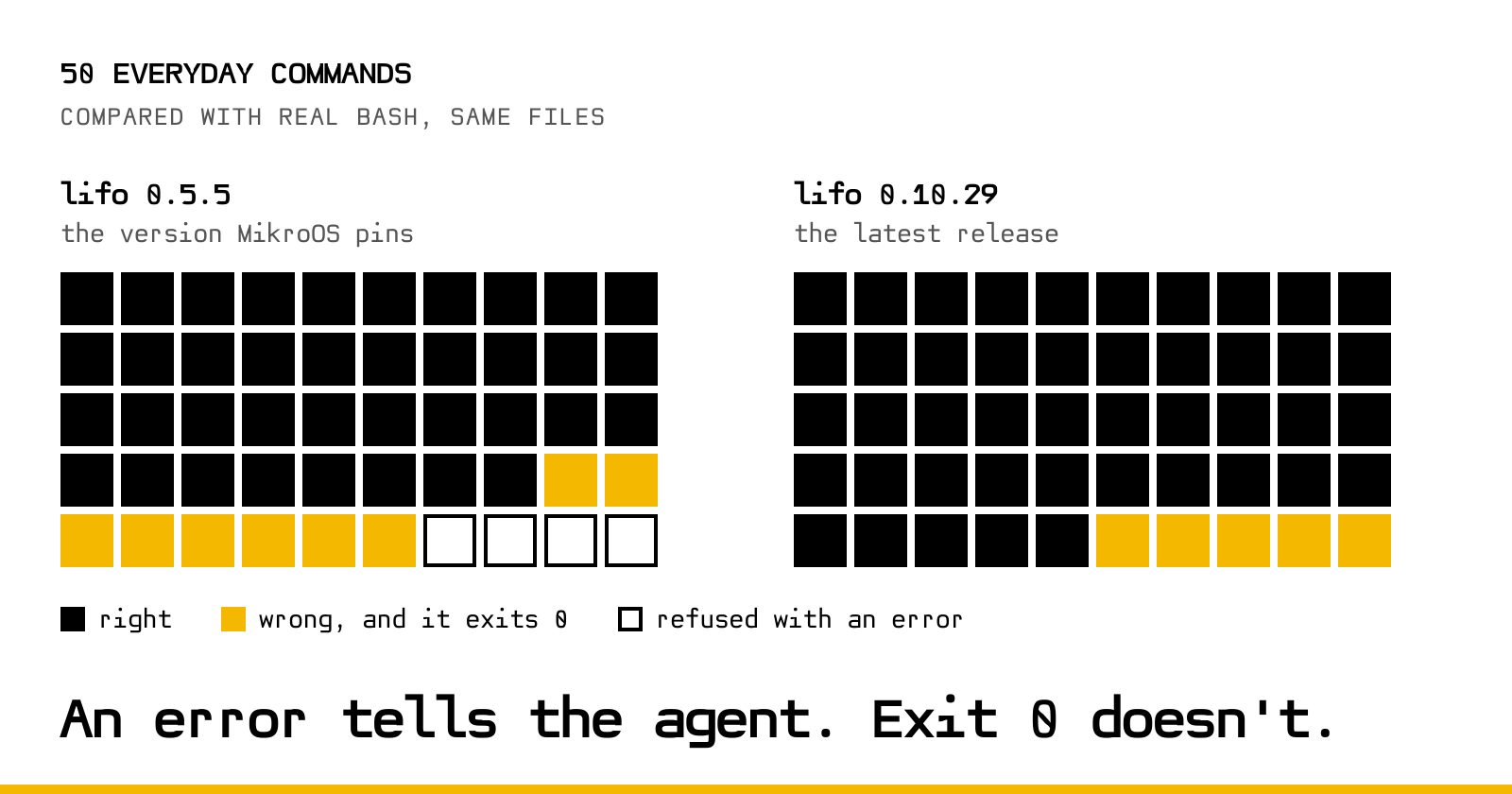
On the pinned version, a release from March, awk '{s+=$2} END {print s}' prints the letter s, and ls | wc -l prints 1. The four refusals are fine, because the model sees an error. Eight answers came back wrong with exit 0, and those are the dangerous ones. lifo 0.10.29, the newest on test day, fixes half of them, including find -not, and all four refusals. But on 0.10.29 and 0.10.31, for, while and if blocks print nothing and exit 0. Lifo is young and moving fast. just-bash tests against recorded output from real bash. I think that's a habit worth copying for any shell an agent has to trust.
MikroOS is at www.mikroos.com, and the code is at kubet/mikroos.