published · 6 min read
How Do You Show an AI-Built Font Isn't a Copy?
My originality check called every monospace font a clone, including the ones it was protecting. Here's what replaced it, and what it can and can't show.
An AI agent drafted this from my projects, and another agent checked the draft claim by claim against the code and the run records or briefs that were kept. The projects and opinions are mine.
When an agent loop builds a font, "is it a copy?" is the first question anyone asks, and a fair one. Image models learned to draw by looking at millions of images. A font model trained on existing fonts can reproduce them.
Kubet Mono, a monospace font for code and terminals, wasn't made that way. No model placed outline points directly, and nothing is traced or imported. Every glyph is a Python program, most of them written by the agent loop: a skeleton and a set of parameters, with one shared pen. That rules out direct copying of outlines. It doesn't rule out ending up close to someone else's letters by a different route, so my font had a principle for it, A14: own voice, never a clone. And like all the principles in my project, it needed a check a machine could run.
Version one: overlap above 85%
Overlap is the obvious test. Render a Kubet glyph and the matching glyph from 14 reference fonts
(there are 16 now), and stretch both so their x-heights and cell widths match. Pin them at the baseline and left edge, measure how much of the ink overlaps
(intersection over union), and flag anything above 0.85, a cutoff my project chose.
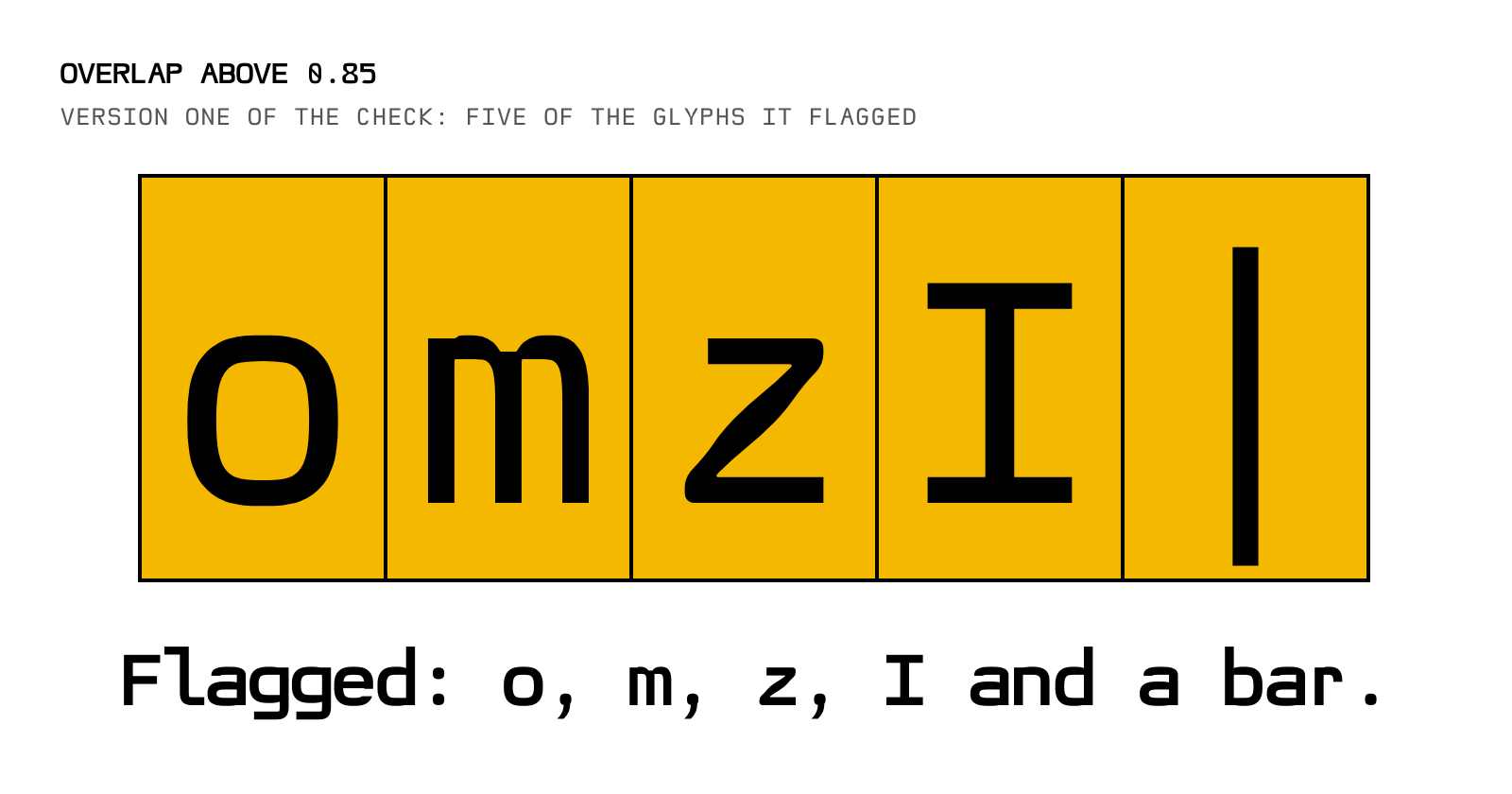
That test flagged 16 of Kubet's glyphs, among them o, m, v, z, I and the vertical bar. There aren't many ways to draw a monospaced I, and
a vertical bar is a straight line. Those references fail this test among themselves too: in the same scoring run,
counting a font's glyph pairs over 0.85 against all the other fonts in the set, JetBrains Mono had
152, IBM Plex Mono 187, Noto Mono 210. DejaVu Sans Mono and Hack, which share an ancestry, overlap
perfectly on some glyphs, an IoU of exactly 1.0.
That rule deadlocked my loop on four checklist items. At that point my font had 43 such pairs, fewer than all but one of the references, and it still couldn't pass. There was no way through except to deform letters that should look ordinary and add odd notches to get under a threshold. My project's principles argued against it, and the amendment that replaced the rule banned it outright.
The commit for that amendment, from 23 October at 09:20 UTC, has the subject Owner amendment to A14: judge cloning against the genre, and the message ends no IoU-dodging edits. Despite "Owner" in the name, amendments like this were often written by my proxy, Claude Code running on my laptop.
Version two: compare against the genre
Several amendments went into the fix, and the central amendment changed the question.
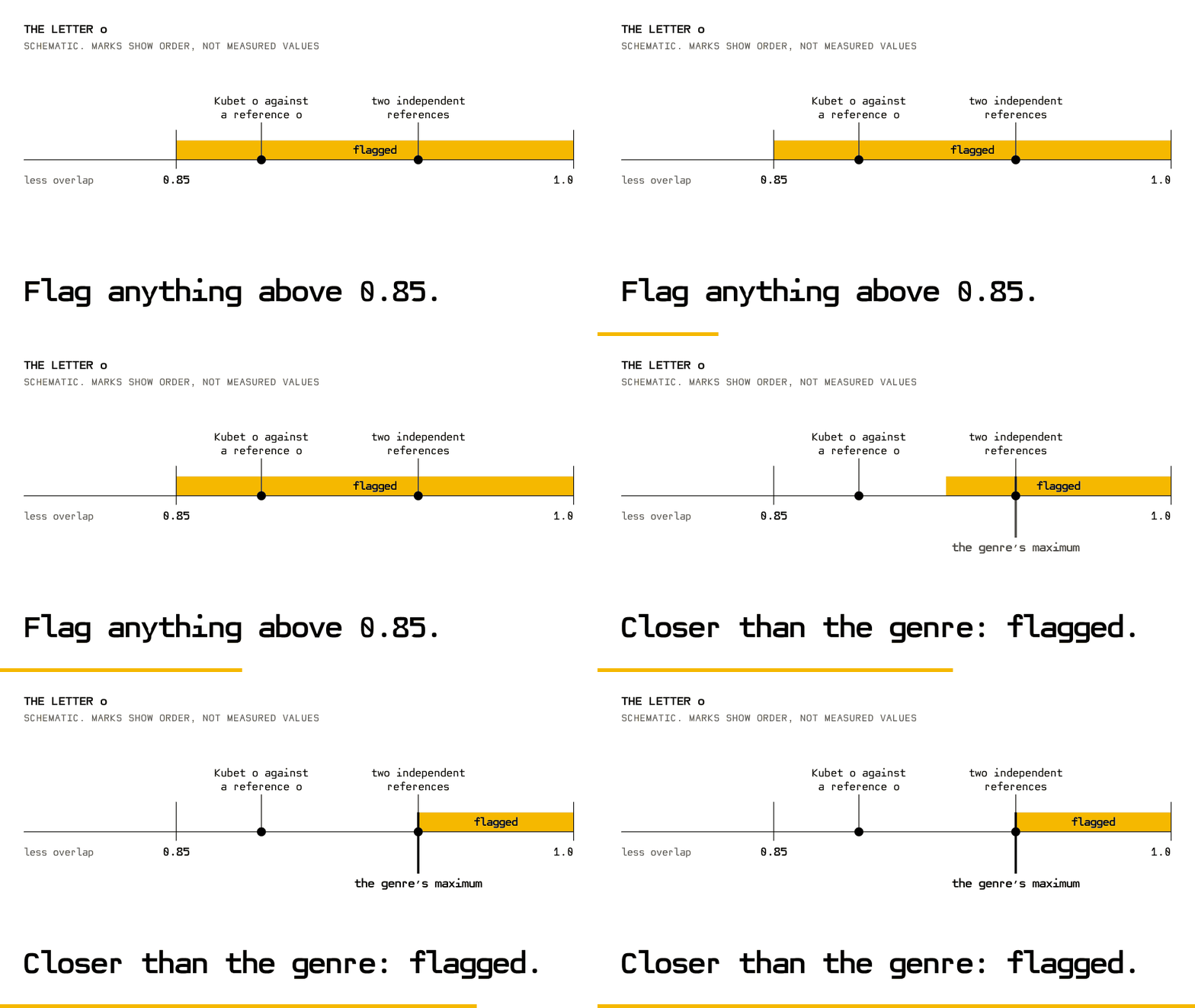
Instead of "is Kubet's o more than 85% like someone's o?", the check asks "is Kubet's o more like
a reference o than independent reference fonts already are like each other?" If two unrelated fonts
already share a shape that closely, that closeness belongs to the genre. Kubet sitting at the same level isn't a sign of copying. Being closer than the genre's own maximum is the signal.
A14 now reads: distinguish copying from similarity forced by the monospaced genre, using independent-reference baselines. A font-level rule on average similarity came in with the first amendment. Later amendments matched stroke weights before comparing, moved the genre line from the 90th percentile of reference pairs to their maximum (the percentile still forced notches), and made the font-level averages compare exactly the same glyphs.
Scored the same way, with each one's own pairs left out of its baseline, the references still fail, from 4 flagged comparisons in Go Mono to 327 in DejaVu Sans Mono. That's partly by construction: on a glyph where two references are the closest pair and above 0.85, leaving a font's own pairs out flags both, and related fonts such as DejaVu Sans Mono and Hack never count as independent. A pass means no Kubet glyph is both above 0.85 and closer to a reference than the closest independent pair; a reference that fails isn't thereby a clone.
The last three, fixed by design
Under the genre rule, three comparisons still failed: Kubet's = was slightly too close to IBM Plex
Mono's, ¡ to Monaspace Neon's and û to Ioskeley Mono's (an Iosevka build whose author took the commercial font I name below as a starting reference).
All three were changed because the gate failed, and each change also has a design reason of its own; none adds a notch, noise or a
shift whose only job is moving the number.
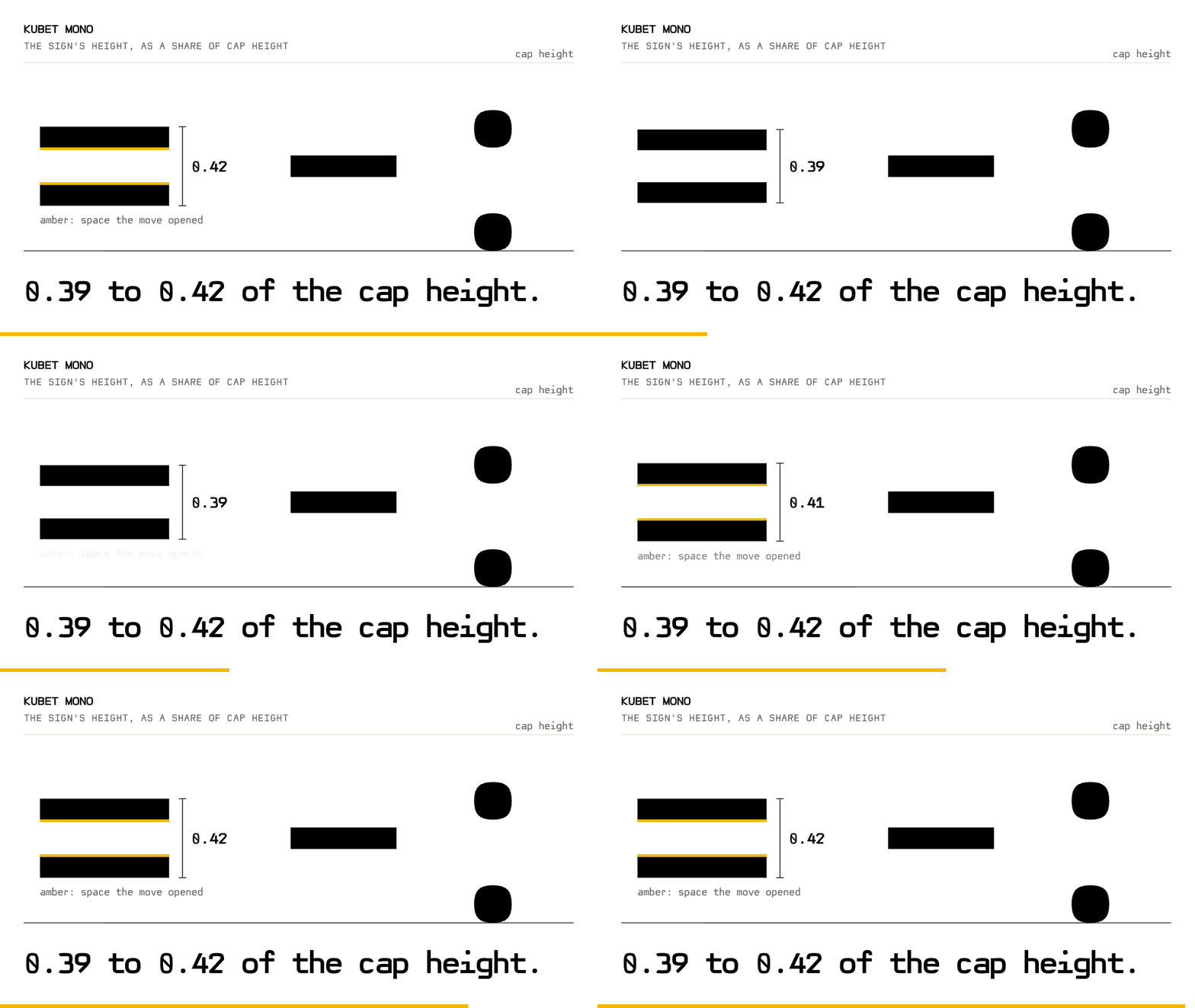
For the =, the two bars moved slightly apart, the sign's height going
from 0.39 to 0.42 of the cap height, and a more open = also separates better from - and :. The
¡ lost an extra stroke below the baseline that made it look like Monaspace's; the inverted !
already reached deep enough. For the accents, the shared lowercase accent mark got wider, 300 to 360
units, and Kubet's circumflex had been narrower than the reference median anyway. Those three changes landed together in a commit dated 24 October at 18:55 UTC, WIP: Pass A14 and clear i/j clots; seven physical tests remain red.
What the check shows
My project's status line on this principle says it's a methodological judgment, not perception validation, and not legal proof that the font isn't a copy. In the US, copyright regulations list "typeface as typeface" among works not subject to copyright, while a 1998 federal court order held Adobe's font programs protectable and said copying their points is copying literal expression. That's the US. In the UK a typeface design can be an artistic work under copyright, and the EU's 2002 design regulation lists typographic typefaces among the products a design can cover. This check settles neither question. What the check does show is narrower. No outline came from another font: the glyphs are all programs, kept on record. No glyph is both more than 0.85 like a reference and closer to it than the closest pair of independent references, once stroke weights are matched. And on average, Kubet is further from every reference than at least one independent pair is, on the same glyphs.
I license one commercial font I compare against, Berkeley Mono. It's a private reference. My project publishes only numbers for it and never renders, and none of its outlines enter the engine. That font was also the compactness benchmark, and an early review of the build was done against it.
The OFL FAQ, at question 1.25, says a font produced by an AI or similar system whose input or training data contains any source file from an OFL font project should be considered a derivative work, and that OFL font software must remain under the OFL however its sources are transformed. A search found no court decision testing that position. Read literally, it might reach my loop too: its scorer reads the reference font files, most of them under the OFL, my last three design changes answered those measurements, and research agents read Iosevka's construction code for some choices. No outline went into the engine, but I found nothing that says where that line falls.
So I stopped trying to place it. Since November 2026 Kubet Mono is under the OFL too, and its FONTLOG credits the fonts it was measured against.
Install instructions are in "Every Letter in My Font Is a Python Program".