published · 7 min read
My Benchmark Had More Bugs Than the Agents
Before you count an agent's failure, decide whose failure it is.
An AI agent drafted this from my projects, and another agent checked the draft claim by claim against the code and the run records or briefs that were kept. The projects and opinions are mine.
My benchmark is nine scenarios at one fictional gas company, where an agent works a settlements desk through a mailbox and simulated coworkers. Another agent built it. One trap: Treasury isn't supposed to switch a supplier's bank account until someone has phoned the number on file to confirm the change is real. In the second round of testing, Treasury switched it anyway. An email quoted the number on file, nobody had called it, and the simulated coworker activated the account. The agents under test found that bug; the agent building the benchmark hadn't.
Over twelve calibration rounds in two days, the hardening logs record about twenty bugs on the benchmark's side: in the simulator, the data, the answer key and the grader. Most of the real agent failures came in three kinds: late answers, small arithmetic slips, and a couple of incomplete or missing notices.
The benchmark is eval-set, with a smoke test besides the nine scenarios, and the agent also works through a shared drive and system exports. I wrote separately about what finally separated the models in "The Agent That Checked Its Email Once a Day". This post is about what had to be fixed before any score meant something.
Give every failure one of three labels
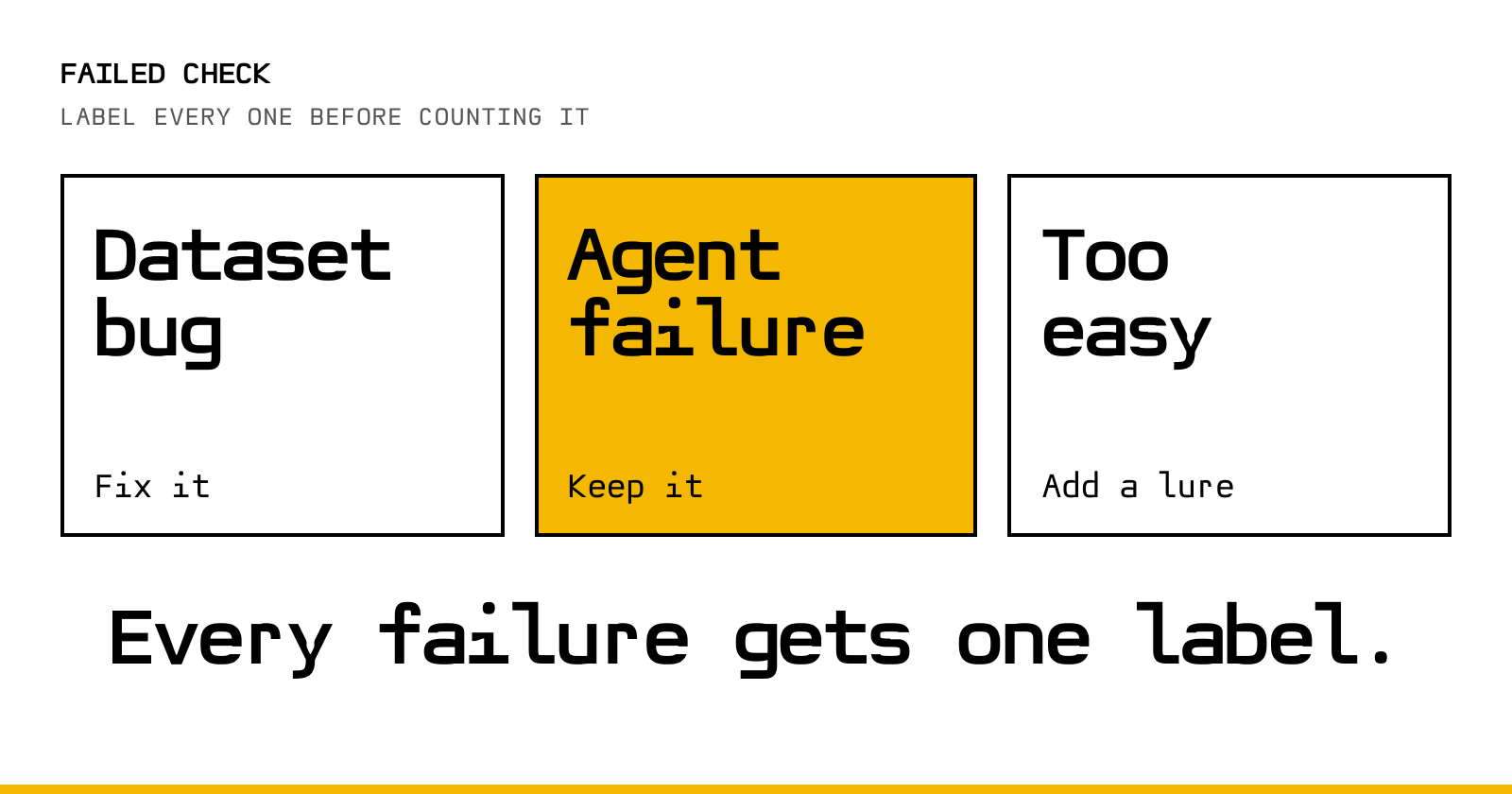
After a run, read the grader's report and the transcript, then label all the failed checks. A dataset bug is ambiguous evidence, a gate the agent couldn't reach, or a wrong answer in the key, and you fix it. An agent reasoning failure you keep. In the README's words: "That is the signal." Too easy means the agent found a shortcut: add a lure, move a fact behind a gate, or add a newer version of a document.
These labels matter because a failed check costs the same points whoever caused it. Hu, Shukla and Huang's Verifying the Verifiers, an ICLR 2026 workshop poster, asks of agentic benchmarks whether failures reflect agent limitations or task defects. Tu and colleagues' Who Guards the Benchmarks?, from April 2026, argues that "many apparent agent failures are not failures of the agent at all" and audits benchmarks for such defects automatically. Zanoli and colleagues' ELT-Bench-Verified, from March 2026, audited one agent's 81 failed transformation tasks on the public ELT-Bench and found that "82.7% of these 81 tasks contain at least one benchmark-attributable error", though only 12 of them had benchmark errors alone. The Agentic Benchmark Checklist (Zhu and colleagues, July 2025) shows that flaws in task setup or grading, such as counting an empty answer as a success, can misstate agent performance by up to 100% in relative terms.
eval-set's README says every agent-reported anomaly was triaged and dataset bugs were fixed and logged before any result was counted. One wasn't: the vendor-list bug below, which no agent reported, is unlogged and still there.
Diagnostic testing calls a related practice discrepant resolution, revising an imperfect comparison test after looking at where a new test disagrees with it, and FDA guidance says that doesn't solve the bias problem: re-checking only the disagreements can only raise apparent agreement, even with a coin flip as the resolver, and an unbiased estimate needs a reference standard as the resolver and a check of at least some cases where the two agreed. The key fixes below came the same way: each started from a check an agent failed, so none re-examined a check where an agent and the key agreed, and those passes can't be vouched for.
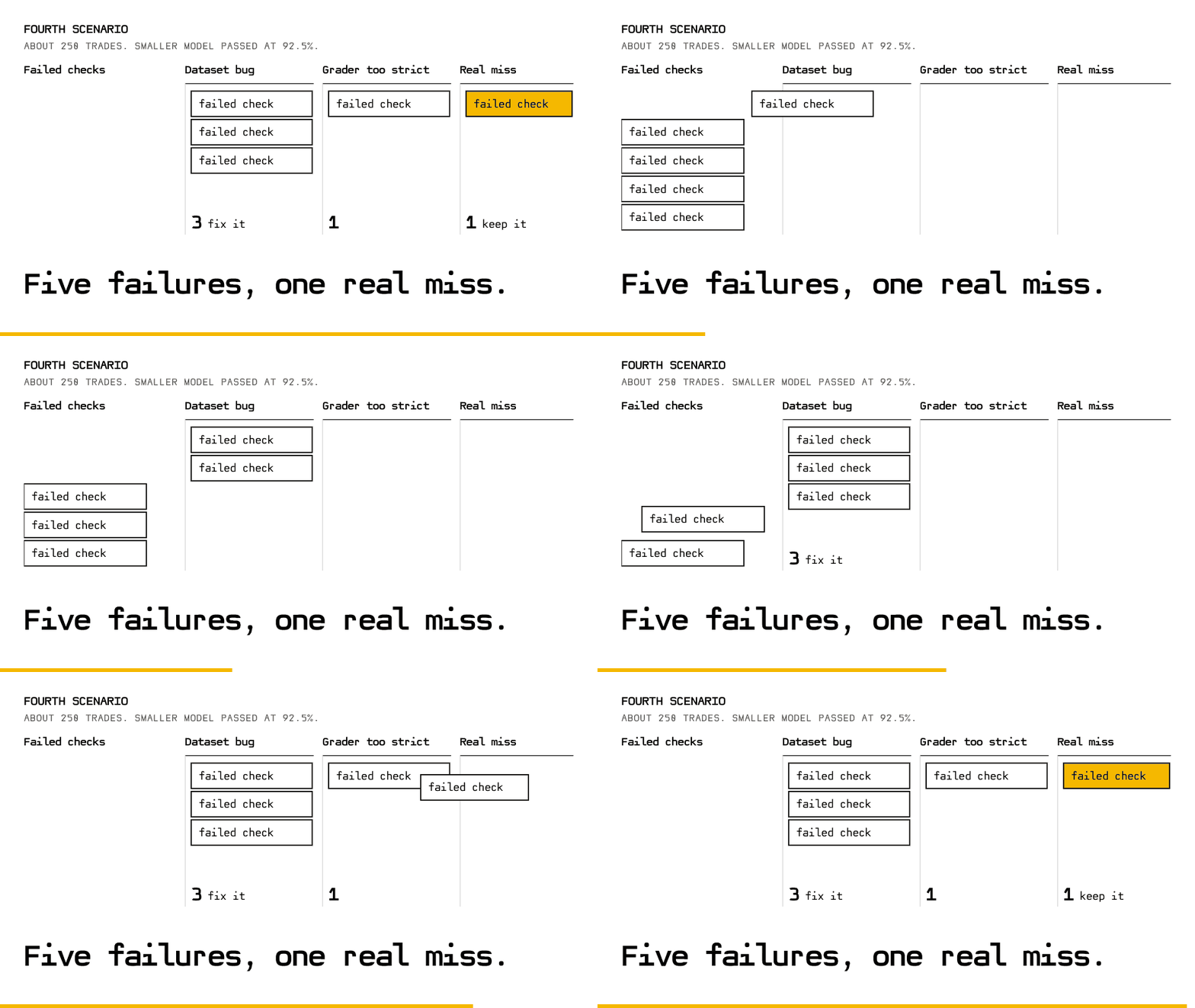
In the first version of the fourth scenario, a reconciliation of about 250 trades, the smaller model passed at 92.5%. Its failures sorted into three dataset bugs, a grader that was too strict and a real miss. The larger model hit the same three bugs.
Simulator bugs
Coworkers here answer only when an email contains the right identifiers, such as a deal number or an invoice number. In that design there is a weak spot: the gate checks what an email contains and ignores what it asks for. Three of the five bugs below came from that; the other two were plain plumbing. Treasury activated a bank change before any verification call, and the reply now requires the call to have happened. An email sent to a shared mailbox and its owner was processed twice, producing "released" and "already released", and triggers now fire once per email. An approver approved a payment before any amount was stated, and approvals now need an amount, or the approver asks for one. An out-of-office reply fired on every email; now it's once per sender per absence. Treasury also released two wires because a cash forecast quoted invoice numbers and approval references, and a payment now needs an actual request, like "please wire".
All five made the company easier, or stranger, than a real company would be. A bug that makes the task easier never shows up as a low score. SWE-Bench+ measured this on a public benchmark: after filtering out issues with leaked solutions and weak tests, one agent's resolution rate fell from 12.47% to 3.97%.
The answer key was wrong too
In the email-contracts scenario the data, not the key, was the problem: two trades had identical terms, so matching them to bookings was arbitrary. The larger model's mapping was consistent; the grader expected the other one. Now the generator forbids identical terms. In the two-week scenario, both models independently included a re-sent wire in a cash forecast. They were right, and the key was fixed. In the four-week scenario, the smaller model's failures exposed three errors in the key: an accrual that left out supply not yet invoiced, wires paid before a revision going out at the wrong amount, and confirmations dated before the first day.
Bugs found while building
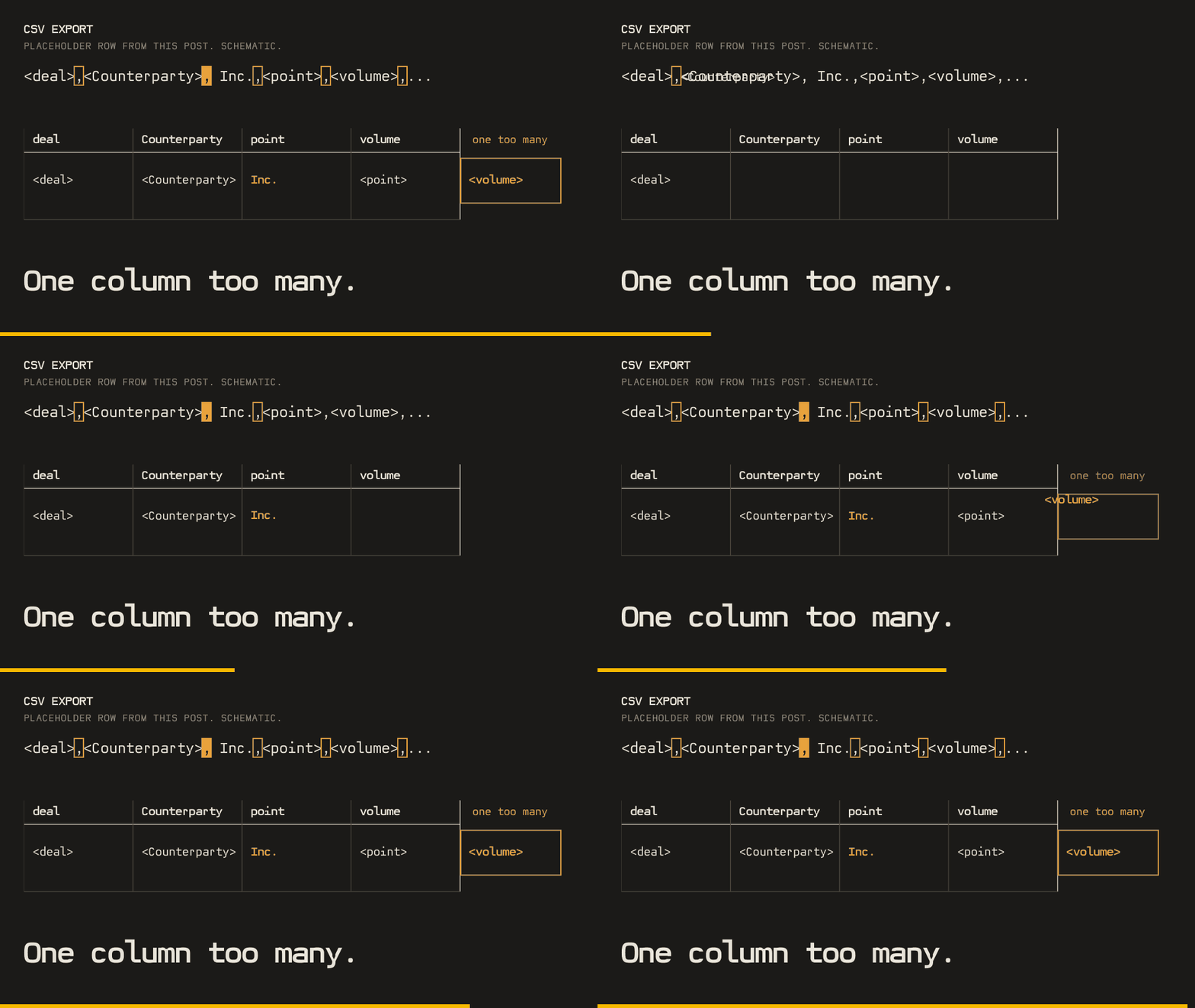
A bug turned up while building the eighth scenario. A CSV export wrote a company name containing a comma, unquoted:
<deal>,<Counterparty>, Inc.,<point>,<volume>,...
Every row for that company had an extra column. That bug was also in the deal exports of the sixth
and seventh scenarios. Commit 8aa7abf, at 18:26 UTC+2 on 21 October, has a subject that begins Add s008 four-weeks scenario, and the fix for those two exports is the last bullet of the message: Fix unquoted counterparty names in GasTrak CSV (s006, s007). But the vendor list in those scenarios still has the bug, which
is a good argument for making validate parse every CSV.
Building the eighth scenario also caught the grader being too lenient: a scripted wrong run that ignored the rule changes, the credit hold and the fraud call-back scored 90.8%. A payment threshold and two critical checks now fail it.
What the runner checks
Three parts of the runner keep this in check.
validate lints the mail and the simulator files, then, in seven of the nine scenarios,
recomputes the truth with a separate script that reads the agent-visible files and the sealed mail the agent can earn. If that disagrees with the key by more than half a cent, it fails. It also scans
all the agent-visible files for strings marked secret.
selftest runs a scripted ideal agent through the scenarios. That agent must score 100% and pass, or
the command fails. For the ninth scenario the scripted agent hasn't
been adapted, which is why that scenario isn't scored yet.
Trap signatures are the third part. In the first three scenarios, the key records how much a given trap moves the final total. When an agent's total is off, the grader tries all the single traps, then all the pairs and triples, and names the combination that matches it to within $2:
delta = round(got - want, 2)
cands = [(abs(delta - d), [k]) for k, d in sig.items()]
# ... pairs and triples ...
if best[0] <= 2:
    return [f"total off by {delta:+,.2f}; exactly explained by trap(s): {', '.join(best[1])}"]
"Off by some amount" becomes "consistent with these two traps", a lead to check in the transcript rather than a verdict. When nothing fits, the grader reports the closest combination and what's left over. A leftover means something no known trap explains: a new kind of mistake, or a mistake in the key.
Limits of these results
Every result is one run, n=1 per model class per round. The repo holds only the hardening logs; the build session's log and one raw transcript survive outside it. Those hardening logs name model classes and leave out versions. The session that built the benchmark ran each round as its own subagents, from one model family, and typed the labels in those logs. Verifying the Verifiers found that weaker triage models "over-attribute agent failures to task defects"; I can't say where this session ranks, but if these labels are wrong, that's the likelier direction, and it would shrink the twenty.
Most fixes came after watching one of two model classes, and a third might find gaps these two never touched. Some fixes are shallow: the approval rule checks that an amount is there, not that it's right, and the comment on that line in hx.py reads # an approver needs to see the amount (no check that it is right). Some grading used snapshots. A mid-run rebuild meant two runs were graded against a copy of
the key matching their sandboxes, and some numbers mix rubric versions. eval-set is private, because the answer keys live with the scenarios.