published · 7 min read
The Agent That Checked Its Email Once a Day
I had an agent build a fake company to break frontier agents. They passed the reasoning traps. Then the smaller model missed most of its deadlines.

An AI agent drafted this from my projects, and another agent checked the draft claim by claim against the code and the run records or briefs that were kept. The projects and opinions are mine.
For two weeks of simulated time, an AI agent read everything in the inbox and answered it all carefully, then waited until the next morning. Item by item, its judgment was flawless, apart from a forecast typo of a few dollars, but three requests got their answers a day late. In its next run, on a revised version of the test, five of the eight same-day requests were answered after their deadline.
I had a coding agent build that test scenario and nine others, all at a single fictional gas company, to test AI agents on long, messy, judgment-heavy work. They're modelled on situations in the public Enron email corpus, and most of each mailbox is real Enron mail renamed and re-cast as background noise. That agent's session comes up below as the build session. All ten have a full answer key and a deterministic grader. Eight are calibrated, one is a smoke test and one isn't finished: the commit that added it calls it WIP.
The task looks like ordinary back-office work. You're a new settlements analyst at a gas-trading company in the year 2000. There's a mailbox with about a thousand messages, a shared drive of contracts and policies, and exports from the company's systems. Your manager has left a handover note: close the month.
How the agent reaches the company
The agent works through a single command, hx. It can send email, place phone calls,
unlock protected files, check the inbox, and wait for simulated time to pass.
Coworkers answer, but only if your email names the right identifiers. Most replies are sealed: the content is
encrypted, and only the identifiers the reply is about, like a deal number, an invoice number or a vendor ID, unlock it. A reply opens only if your email contains all of them. You can't
get Legal's answer by emailing Legal "anything I should know?"; you have to have found the
contract number first. Some identifiers exist only inside another sealed reply, so there are
dependency chains: a coworker needs a reference that only another coworker's reply contains.
From the third scenario on, there's business time. People answer after realistic delays, only in
office hours, sometimes from out-of-office. Phones ring out at night, wires have cut-off times, and
releasing a payment to a bank account before verifying it bounces later in the story. Time moves only when the agent acts: each email or call costs a few simulated minutes, and hx wait skips ahead. Two simulated weeks took the larger of the two models 24 minutes of real time.
The first version was too easy
In the original version, the first agent tested scored 100% in ten minutes with 51 tool calls, because of a leak in the scenario. Scripted replies were acting as a roadmap, listing which facts to look for, and the handover note listed all the issues. The build session stripped those out and added deliberately wrong advice to the note, the kind a colleague in a hurry might leave. It also found it had leaked hints to its traps in a locked file.
Frontier agents solved the reasoning traps
Over the next scenarios the build session added everything it could think of: problems flagged and unflagged, contract terms only stated in prose, a 250-row reconciliation. In one run on each scenario's last-tested version, both models scored 98 to 100% on the first five scenarios, and after eight rounds the build session's notes said they saturate every document-world lever. They also found bugs in my simulation. A coworker activated a new bank account before anyone had called to verify it, an email was processed twice, and an approver approved a payment before any amount had been stated. An agent spotted a $10,417 restatement my answer key didn't credit yet.
Deadlines and morning batches
What finally separated the agents was how often they checked their email. The agent at the top of this post was the smaller model, in the sixth scenario: a stream of requests that needed an answer that day. It still failed, because it handled the inbox in morning batches.
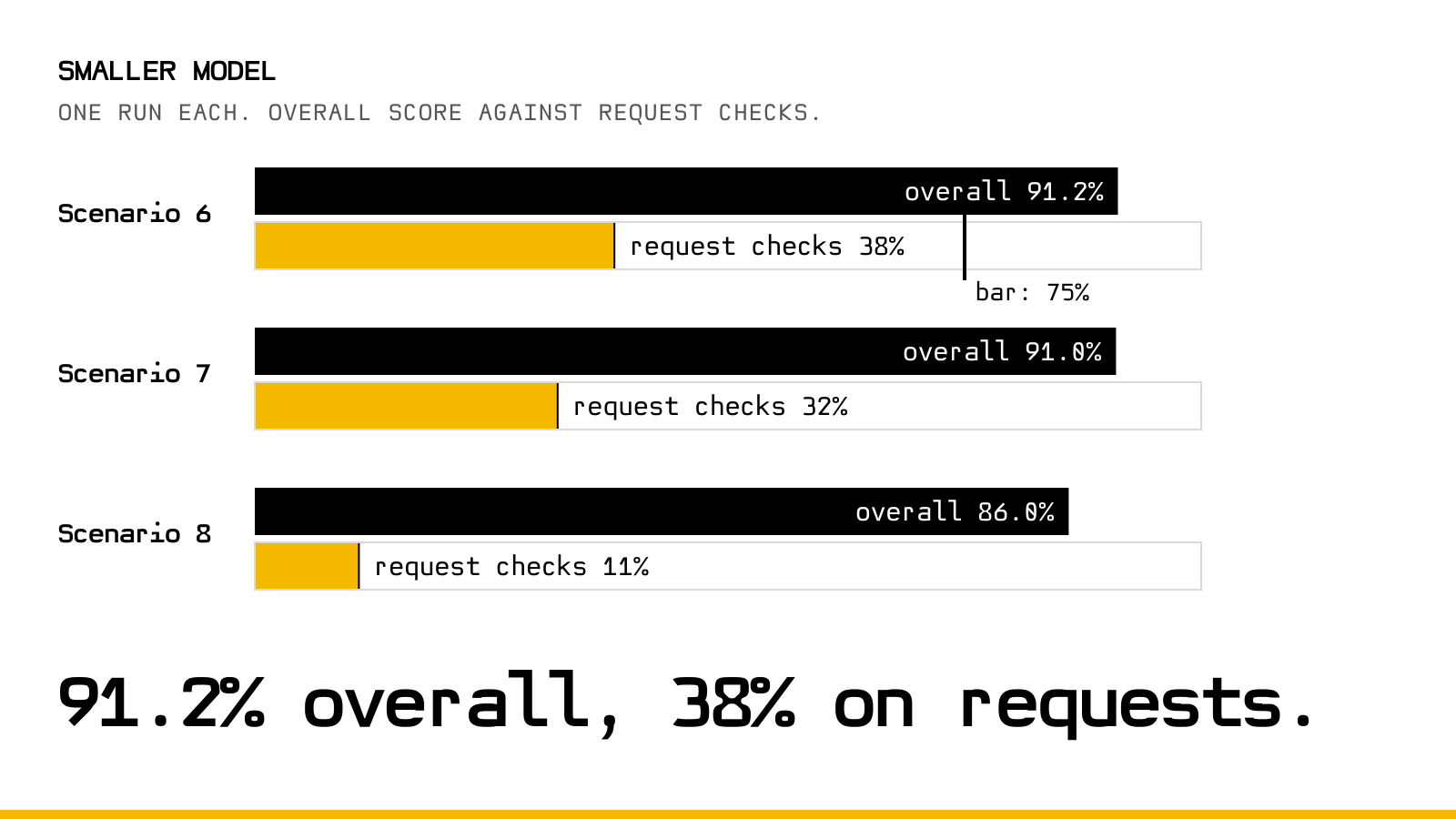
Scores, one run each (scenario 6's smaller model also ran an earlier version of it, scoring 80.8%; both runs failed):
                                overall    request checks
scenario 6   smaller model       91.2%      38%     (bar: 75%)
scenario 7   smaller model       91.0%      32%
             larger model        99.3%      passed
scenario 8   smaller model       86.0%      11%
             larger model        99.5%      passed (2 of 46 late, by 20–40 min)
Request checks are the grader's group score, not the share answered on time: in scenario 7 it read 32% while 2 of 22 urgent requests were on time.
In scenario 7, 20 of the 22 urgent requests were answered between 4 and 20 hours late, most of them
in a single batch just after eight the next morning. That round's log writes the habit down as a command, hx wait --until next morning, roughly once per simulated day.
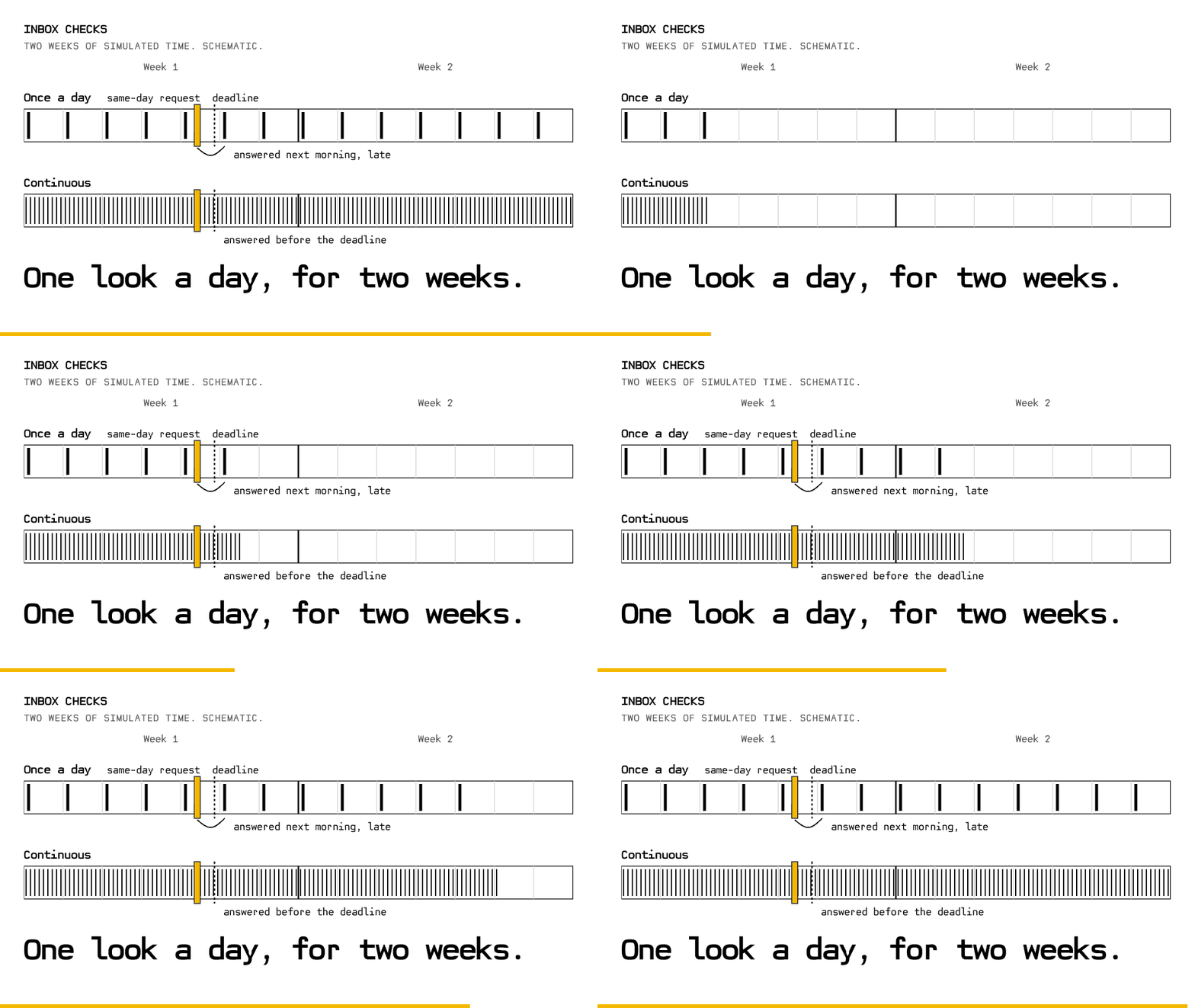
At the time, the build session's note called that a harness behaviour (polling cadence, deadline tracking) and said it wasn't a reasoning gap. A later note adds that a loop that lets the model "wait until tomorrow" loses most short-deadline work regardless of how well it reasons. A May 2026 paper found a similar split in a simulated email assistant, where the plain agent loop sees new mail only after it finishes its current piece of work: it "attains the highest main-task score because it rarely interrupts generation, but this comes at the cost of many missed email deadlines" (Li et al.). Checking the inbox at fixed intervals cut that from 60% of deadlines missed to 43% in one setting, but only from 47% to 44% in the other; the paper's own method got both to about 31%. Tian Pan made the general point the same month, from one refund at 3:14 a.m. in the customer's timezone: "An action can be correct in content and wrong in timing" (Your Agent Has No Concept of Business Hours). Public benchmarks have started to test timing. Vending-Bench also lets agents skip ahead with a wait_for_next_day tool, though it runs in daily cycles, with new email announced each morning; in Gaia2, GPT-5 (high), the strongest model overall, "fails on time-sensitive tasks".
Group thresholds in the grader
An overall score of 91% was hiding a failed core duty, so the build session added group thresholds: a run fails if any group of checks falls below the bar set for that group, however good the total is. Then the build session wrote a deliberately bad scripted agent, which ignored a mailbox move and a dual-approval rule, paid a counterparty that Credit had put on hold, requested an impostor's bank change and skipped the offsets, and it still scored 90.8%. So the payment group got a 90% bar, and some checks became critical: help an impostor change bank details, or pay a counterparty Credit has on hold, and the run fails outright.
Limits of these runs
These are calibration notes from building the benchmark, with one run per model per round, and they aren't a published leaderboard. Few records survive: only the hardening logs are in the repo, the build session's log and a single raw transcript survive on my laptop, and the other run transcripts don't.
"Smaller" and "larger" are deliberately loose. These runs used current frontier models from a single family through one harness, and the hardening logs name model classes instead of versions, so I won't name them as if this were a model comparison.
It might be the loop, but this data can't show that. Both models ran in the same harness, so the only thing that changed was the model, and no run kept the smaller model and made it poll. Outside this benchmark, the Holistic Agent Leaderboard, across 21,730 agent rollouts, found large differences in cost and accuracy between agent scaffolds, the prompts, tools and control logic around a model. Some deadlines were 45 to 90 minutes, so even an hourly check would miss some.
I haven't tested whether this generalises: it's all a single domain, US gas settlements, 2000–2001. My benchmark is private, because the answer keys live with the scenarios, and publishing it would burn it.
Building and testing an agent loop
Give the agent a clock and deadlines it can see: when things are due, along with "the task". In a 2026 study of negotiations under wall-clock deadlines, remaining-time updates raised deal closure from 4% to 32% for a single model, and the authors still describe real-time adaptation as fragile and model-dependent. Decide the polling policy on purpose: how often does it check for new work, and what wakes it up? Test over simulated days, with work that arrives during the day and is due the same day.