published · 7 min read
I Had My Own Market Researched, and It Refuted My Pitch
Eight research lanes planned, four finished, three of my own bets knocked down by desk research, one DO_NOT_BUILD, and a fabricated quote that made it into four files.
An AI agent drafted this from my projects, and another agent checked the draft claim by claim against the code and the run records or briefs that were kept. The projects and opinions are mine.
In June I started building something I was sure was a good idea. Verse runs a small program on a machine you don't trust, then has an independent machine re-run it. If the two outputs aren't byte-identical, the protocol treats the first machine as having lied, and that machine's own signed receipt is the evidence. By the end of July I had dozens of design notes, a working network, a test suite, and a report from research agents that, section by section, took my pitch apart.
The warning I'd already had
A research pass on July 2, the pass that produced my direction document, already said it plainly: token-free verifiable compute has zero paying users in 2026. It also proposed a market I'd go after, reproducible builds, which the later research would knock down. The message on the commit that added the document says "VERSE is not a compute marketplace and never will be".
Verse has no blockchain or token, though a trusted committee decides who is punished. In crypto, the systems that check outsourced work today build elaborate dispute games because their referee is a blockchain that can't afford to re-run the job. My design had a full node as referee, which could. My design notes called this "a simplification, not an invention", though that re-run isn't built yet.
I kept building.
Commissioning the research
At the end of July I had research agents look at the market properly, in separate lanes: the crypto-native verifiable-compute field; reproducible builds and supply-chain security; scientific reproducibility; and the market for floating-point determinism. Eight lanes were planned. Four finished before the run hit the budget ceiling, and the report says so in the first section. Three didn't run (the report doesn't say what became of the eighth); a later pass answered two of their questions, and go-to-market is still open. Every finding, the report says, carries a primary source that was actually fetched.
Bet one: "reproducible builds is the adjacent market"
My design notes called reproducible builds "the adjacent mature pull", and the research said no: the field had already built my product, and it wanted the opposite semantics.
- A widely used rebuild service already emits signed attestations of each rebuild, signed by both the worker and the instance, which is my receipt, built earlier by someone else.
- An experimental apt transport already enforces "only install packages reproduced by multiple groups you trust", which is my permissioned verifier set, wired into apt.
- A funded, professionally built project with my exact idea had gone quiet.
- Google's OSS Rebuild, announced in July 2025, rebuilds packages from PyPI, npm and Crates.io and publishes SLSA provenance. Results get compared semantically after normalizing both artifacts.
Reproducible-builds services are useful, the report argued, because workers in deliberately different environments agree. My receipt pins the runtime's version, and a verifier on a different version abstains. In a market whose product is cross-environment agreement, "abstain unless your environment matches" is an anti-feature. The report's instruction was blunt: delete the sentence. Pinning also shows up in the field's own documents: the definition assumes the same build environment, and Debian's rebuilder fetches the exact dependency versions of the original build and leaves variance testing to a separate system.
Bet two: "scientists want replayable artifacts"
My roadmap had a badge for replayable research artifacts. Looking across artifact evaluation in computer science, economics, high-performance computing and climate science, the research found zero institutions asking for a signed re-execution receipt. What they do use is a lower bar than mine: the top reproducibility badge in one major scheme explicitly allows results within a tolerance. Bit-identical is stronger than what the buyer asked for. In that lane there was a single real, unmet pain: portability, and timeouts caused by slow, noisy evaluation machines. My work meter, which counts instructions instead of seconds, gives a machine-independent measure of work that could stand in for wall-clock timeouts, though some operations cost the same however long they run; on the Wasmtime version I'd pinned then, bulk-memory ones did. That was worth five emails, the report said, before it was worth a build. I haven't sent them.
Bet three: "my deterministic math library is the crown jewel"
Verse had a small library of math functions (exp, ln, sin, cos) built only from the operations the floating-point standard pins down, so they're designed to give identical
bits on every machine, and CI checks that on x86-64 and arm64.
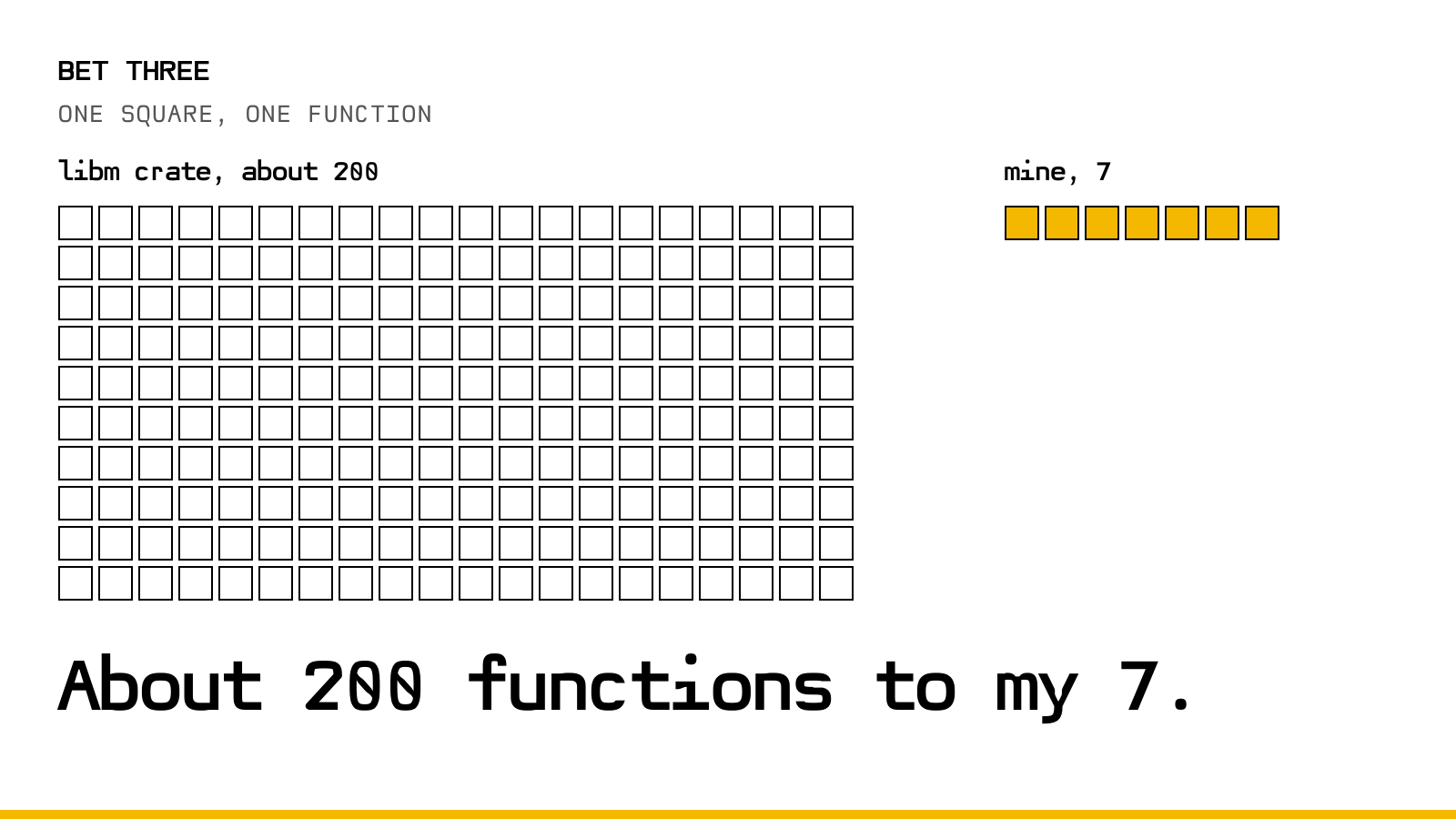
In response the research pointed out that the Rust project's own libm crate has about 200 functions to my 7, and it's
what the people I imagined as users already use. Other projects ship deterministic variants too, and
correctly rounded functions are landing in the C library itself.
The narrow thing, and the ninth lane
Two lanes had pointed at one narrow thing that might survive: a published, CI-checked proof that the
composed functions give identical bits across machines and engines.
I was already building that narrow thing: 255 test vectors. By August 2 those were committed and gated in
CI, passing on three JavaScript and WebAssembly engines. Pointing the
same battery at the libm crate that real projects use was the obvious next feature. A measurement killed that: it would have
caught exactly one function in everything I tested, and a lockfile already fixes that function. That left a
narrower idea, certifying that a build really is routed through libm on every target. So I ran one
more lane on whether anyone would adopt it: five research lanes and three designs, plus an adversarial
judge. It came back DO_NOT_BUILD.
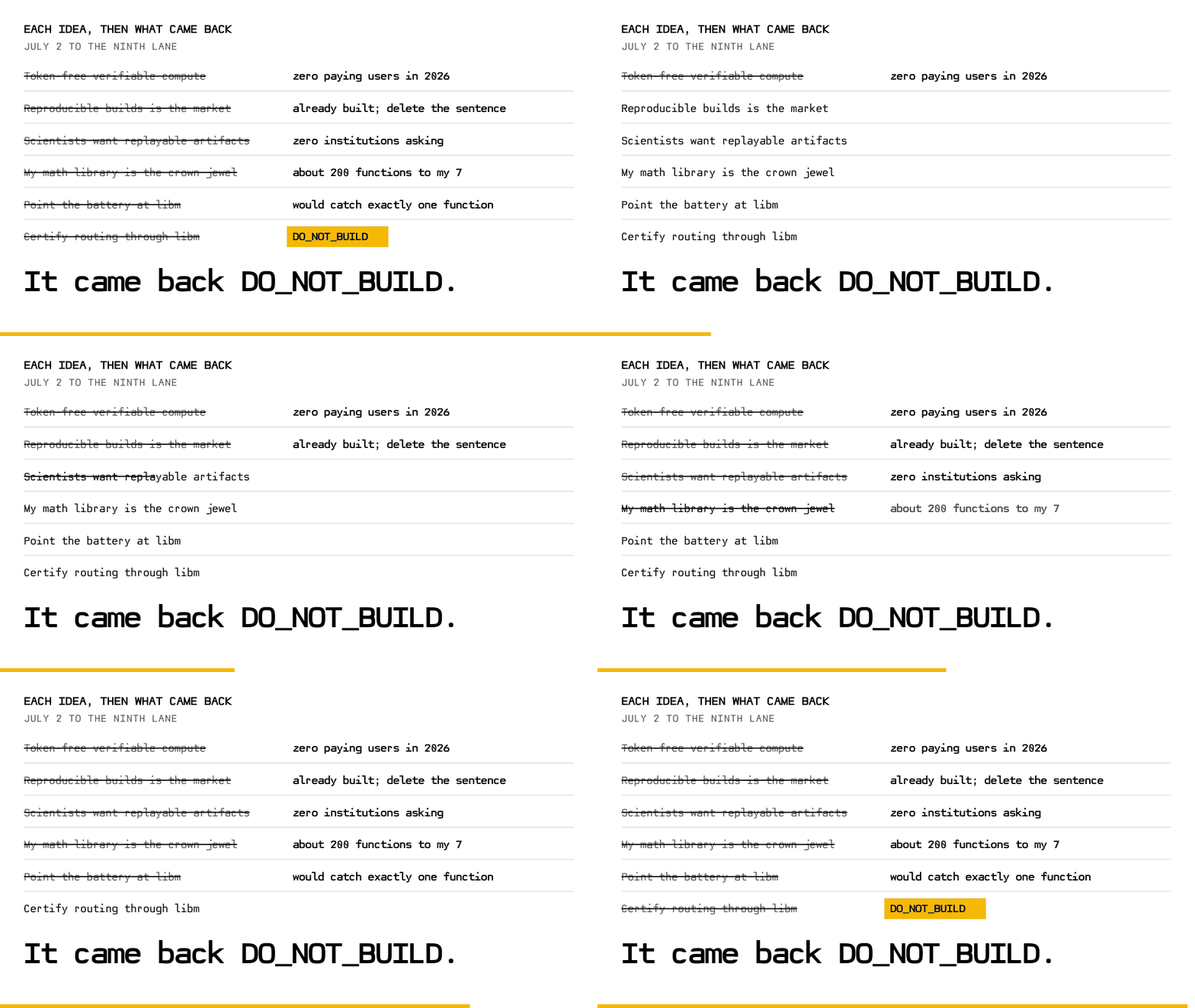
DO_NOT_BUILD came with an argument: the bugs a test battery like that could catch were already impossible, already fixed for free by pinning a lockfile, or out of scope. As for the float-determinism bugs that people had actually filed, those came from somewhere a per-function battery can't see. And the audience I had in mind, game developers doing lockstep netcode, already compare state checksums at runtime, which catches any kind of desync from any cause. Forrest Smith, who worked on the Supreme Commander engine, describes that hashing, done once per second, and wrote that fixing a desync generally meant a binary search through memory hashes. The most promising contribution lead was a project that banned AI-generated contributions at the time, and that's how most of this work had been done.
I kept building Verse itself into September: a local mesh you can start with one command, a few showcase apps, a public release.
The fabricated quote
At one point the research produced a quotation that didn't exist, a line attributed to the Rapier physics engine, "always validate on all target platforms". No record says which model produced it. A separate mistake came from reading a library's source file and paraphrasing it as promising cross-architecture bit-identity. That file doesn't say that, and the comments in it are about performance. Both errors were caught before the report was committed, but by then the quote had reached four files and the libm claim was in a draft of the report itself; a fragment, "validate on all target platforms", is still in the committed report. Even then, three load-bearing quotes in the research dossier were still flagged for a fresh re-fetch. The commit that added the report is stamped 14:52 UTC on August 2, and its message says the quotation "was FABRICATED by an earlier research pass and had reached four files." In the report's last section there's a line: verify the quotes before publishing any of it. A close cousin of that failure has been measured: one study found that 3 to 13% of citation URLs from commercial models and deep-research agents had no Wayback Machine record and likely never existed (Rao, Wong and Callison-Burch, 2026).
What survived
In the conclusion the report listed three things worth keeping, and said plainly that they aren't
products. One was the measurement, the side finding: Rust's default math and the libm crate disagreed on 5% of the 45,996 values tested, the same Rust code gives different math natively and in WebAssembly, and a patch release of libm changed the bits of cbrt on 8% of 20,000 tested inputs.
The report called them new and unpublished; the counts may be, but the causes were on record: Rust's docs warn that sin's precision varies by platform and Rust version, and libm's changelog for that release records the cbrt rewrite, a port of CORE-MATH's correctly rounded version. (Node and Bun also disagree on Math.sin, but
by design.) A write-up of the measurement is on the project site.
Verse itself is still up at https://www.versemesh.org, as a demo with zero users.
Have you ever paid for research that told you to stop? Did you listen?